









Underground coaxial cable installations are widely used in telecommunications, cable television, broadband infrastructure, and other communication systems. While burying cables helps protect them from certain types of physical damage and environmental exposure, underground connections face a significant challenge: moisture intrusion.
Water, soil moisture, temperature changes, and environmental contaminants can affect coaxial cable connections over time. Without appropriate protection, these conditions may lead to corrosion, signal degradation, and costly maintenance.
For technicians and contractors working with RG6, RG11, and other coaxial cable types, protecting splice connections is an essential part of reliable cable installation.
One practical solution is the gel-filled coaxial splice enclosure, which provides an environmental barrier around compatible cable connections.
In this guide, we'll explain why underground coaxial splices require protection, how gel-filled enclosures work, the differences between RG6 and RG11 splice enclosures, and the best practices for maintaining reliable underground cable connections.
1. Why Underground Coaxial Cable Connections Need Protection
Coaxial cables are designed to transmit radio-frequency signals through a central conductor surrounded by insulation and shielding.
Although properly selected outdoor and direct-burial coaxial cables are manufactured to withstand demanding environments, connection points can introduce additional vulnerabilities.
When two coaxial cables are joined, the connectors and exposed connection interfaces require appropriate environmental protection.
Several conditions can affect underground splices.
Moisture and Water Intrusion
Underground environments can expose cable connections to groundwater, rainwater infiltration, and persistent soil moisture.
If moisture reaches the metallic components of a coaxial connector, it may contribute to corrosion and deterioration of the electrical connection.
Water intrusion can also affect the cable's dielectric properties, potentially increasing signal loss.
Corrosion of Metal Components
Coaxial connectors contain metallic components that help maintain electrical continuity and shielding.
Exposure to moisture and contaminants can gradually cause corrosion, increasing the risk of poor connections and signal instability.
Temperature Changes
In Canada, underground installations experience seasonal temperature variations.
Thermal expansion and contraction can place stress on cable connections and surrounding materials. Freeze-thaw conditions may also affect the ground surrounding buried infrastructure.
Mechanical Stress
Soil movement, improper cable support, excessive pulling tension, and poor installation practices may place unnecessary stress on underground cable connections.
An environmental enclosure is only one part of the solution. Proper cable routing and mechanical protection remain essential.
The key takeaway: A reliable underground coaxial connection requires both a properly installed electrical splice and an enclosure suitable for the surrounding environment.
2. What Is a Gel-Filled Coaxial Splice Enclosure?
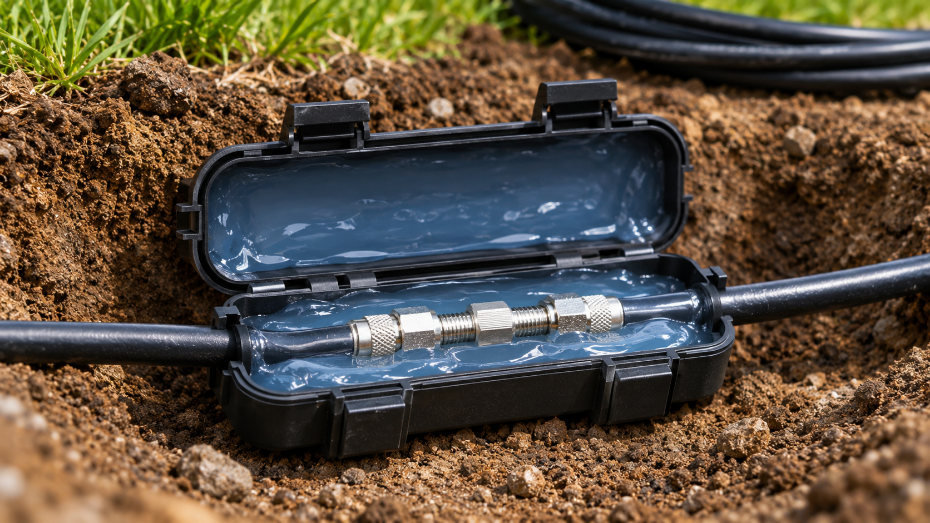
A gel-filled coaxial splice enclosure is a protective housing designed to surround a compatible coaxial cable connection.
The enclosure contains a sealing gel that helps form an environmental barrier around the connection.
Unlike a basic plastic housing with no sealing material, a gel-filled enclosure is intended to reduce moisture exposure at the protected connection.
These products are commonly used in outside-plant telecommunications work and other applications where coaxial connections require protection from environmental conditions.
How Does a Gel-Filled Splice Enclosure Work?
The operating principle is straightforward.
Once the coaxial cables have been properly terminated and joined using compatible connectors, the connection is positioned inside the enclosure.
When the enclosure is closed according to the manufacturer's instructions, the sealing gel conforms around the connection and helps limit moisture intrusion.
The effectiveness of the seal depends on correct installation, compatible cable dimensions, and the enclosure's intended application.
Advantages of Gel-Filled Splice Enclosures
Moisture resistance: The sealing gel helps protect the enclosed connection from environmental moisture.
Connection protection: The housing provides an additional barrier around the splice.
Convenient installation: Some designs use snap-on housings that simplify enclosure installation.
Application flexibility: Properly rated models may be suitable for underground or aerial telecommunications installations.
Reduced exposure: Protecting connection interfaces can help reduce the risk of moisture-related deterioration.
For technicians working with outside-plant coaxial networks, these features make gel-filled splice enclosures a practical component of cable protection.
3. Understanding RG6 and RG11 Coaxial Cable Connections
Two commonly used coaxial cable types are RG6 and RG11.
Although both are used for radio-frequency signal transmission, their physical dimensions and performance characteristics differ.
RG6 Coaxial Cable
RG6 is commonly used in cable television, broadband, satellite, and residential distribution systems.
Its relatively compact diameter makes it practical for many standard coaxial cable installations.
Common applications include:
-
Residential cable television connections
-
Broadband distribution
-
Satellite systems
-
Shorter outdoor coaxial cable runs
-
Telecommunications service connections
RG6 connectors and accessories must be selected for the specific cable construction, including shielding and jacket dimensions.
RG11 Coaxial Cable
RG11 coaxial cable is generally larger in diameter than RG6 and typically provides lower attenuation over comparable cable lengths at the same frequency.
This makes RG11 useful in certain longer-distance distribution applications.
Common applications include:
-
Longer coaxial cable runs
-
Broadband distribution infrastructure
-
Telecommunications outside-plant installations
-
Cable television distribution networks
-
Applications where lower cable attenuation is desirable
Because RG11 cables are physically larger, they generally require connectors and splice protection products designed for their dimensions.
RG6 vs. RG11: Quick Comparison
| Feature | RG6 | RG11 |
|---|---|---|
| Cable diameter | Smaller | Larger |
| Flexibility | Generally more flexible | Generally less flexible |
| Signal attenuation | Generally higher over equivalent runs | Generally lower over equivalent runs |
| Typical use | Residential and distribution connections | Longer distribution runs |
| Enclosure selection | RG6-compatible enclosure | RG11-compatible enclosure |
Selecting the correct enclosure is important because the cable and connector must fit the housing as intended.
4. Click-It Gel-Filled Splice Enclosures for RG6 and RG11
For technicians seeking practical protection for underground coaxial connections, Canada Cable Tools (CCT) offers Click-It gel-filled splice enclosures designed for specific cable series.
These products use a one-piece snap-on housing and a gel-filled sealing design.
Click-It CCT-KP-RG6 Splice Enclosure
The Click-It CCT-KP-RG6 is a gel-filled coaxial coupling closure designed for direct-buried splicing applications involving Series 59 and Series 6 coaxial cables.
Its water-resistant construction provides an environmental seal around the compatible connection.
Key features:
-
Designed for Series 59 and RG6 coaxial cable applications
-
Gel-filled environmental sealing
-
One-piece snap-on housing
-
Intended for direct-burial splice protection
-
Suitable for specified demarcation and aerial applications
-
Listed for low-voltage cable insulation up to 60 volts
This model is a practical option when protecting compatible RG6 coaxial connections in outside-plant installations.
Explore product: Click-It RG6 Gel-Filled Splice Enclosure CCT-KP-RG6
Click-It CCT-KP-RG11 Splice Enclosure
The Click-It CCT-KP-RG11 is designed for direct-buried splicing applications involving Series 7 and Series 11 coaxial cables.
Like the RG6 version, it features a water-resistant gel-filled construction and a convenient one-piece snap-on housing.
Key features:
-
Designed for Series 7 and RG11 coaxial cable applications
-
Gel-filled environmental sealing
-
One-piece snap-on housing
-
Intended for direct-burial splice protection
-
Suitable for specified demarcation and aerial applications
-
Listed for low-voltage cable insulation up to 60 volts
For installers working with compatible larger-diameter coaxial cables, this enclosure provides an appropriate alternative to an RG6-sized housing.
Explore product: Click-It RG11 Gel-Filled Splice Enclosure CCT-KP-RG11
Which Click-It Enclosure Should You Choose?
| Model | Compatible Cable Series | Construction | Intended Applications |
|---|---|---|---|
| CCT-KP-RG6 | Series 59 and RG6 | Gel-filled, snap-on | Direct burial, splice protection, specified aerial uses |
| CCT-KP-RG11 | Series 7 and RG11 | Gel-filled, snap-on | Direct burial, splice protection, specified aerial uses |
Both products are described as water-resistant and designed for compatible low-voltage coaxial applications.
Before installation, verify the cable dimensions, connector configuration, environmental requirements, and manufacturer instructions.
5. How to Protect an Underground Coaxial Cable Splice
Proper protection begins before the enclosure is installed.
The following steps provide a general overview of the process. Always follow the specific instructions for the cable, connectors, and enclosure being used.
Step 1: Choose the Correct Cable and Enclosure
Confirm whether the installation uses RG6, RG11, or another coaxial cable series.
Select a splice enclosure designed for the applicable cable size and installation environment.
For direct-burial applications, the cable itself must also be rated for the intended underground conditions.
Step 2: Prepare the Coaxial Cable
Use a compatible coaxial cable preparation tool to strip the cable according to the connector manufacturer's specifications.
Avoid damaging the centre conductor, dielectric, or shielding.
Improper preparation can compromise electrical performance even when the connection is adequately protected from moisture.
Step 3: Install Compatible Coaxial Connectors
Attach the appropriate connectors using the required termination tools and installation procedure.
Ensure the connectors are properly seated and meet the cable manufacturer's requirements.
A gel-filled enclosure does not replace the need for correct coaxial cable termination.
Step 4: Connect and Inspect the Splice
Join the prepared cables using a suitable coaxial coupling arrangement.
Inspect the connection for mechanical integrity, correct engagement, and visible damage.
Where appropriate, perform electrical or RF testing before enclosing the splice.
Step 5: Install the Gel-Filled Enclosure
Position the completed connection inside the compatible enclosure according to the manufacturer's instructions.
For a snap-on design, close the housing completely as specified.
Avoid modifications that could interfere with the sealing gel or enclosure closure.
Step 6: Protect the Cable from Mechanical Stress
Ensure the splice is not subjected to excessive pulling force, sharp bends, or unsupported movement.
Maintain the cable manufacturer's minimum bend radius and provide appropriate cable support.
Step 7: Complete Installation and Testing
Verify the connection's performance using suitable test equipment and the network operator's acceptance criteria.
If the splice is to be buried, ensure the installation meets applicable utility requirements, burial conditions, and local regulations.
Important: A protective enclosure should not be used to compensate for a damaged connector, improperly prepared cable, or unsuitable installation method.
6. Common Mistakes to Avoid When Splicing Coaxial Cable Underground
Even experienced installers can encounter problems when working with underground coaxial connections.
Several common mistakes can increase the risk of future failures.
Using the Wrong Enclosure Size
An enclosure designed for RG6 may not properly accommodate RG11 cable and connectors.
Always match the enclosure to the specified cable series and verify compatibility with the complete splice assembly.
Assuming Every Outdoor Enclosure Is Suitable for Direct Burial
Outdoor weather resistance and direct-burial suitability are not necessarily the same.
Products intended for underground installation should be explicitly specified for that application.
Improper Cable Preparation
Damaged shielding, an incorrect stripping length, or a poorly installed connector may result in signal problems.
Environmental sealing cannot correct an electrically defective connection.
Failing to Close the Housing Correctly
A gel-filled snap-on enclosure must be fully closed according to its installation instructions.
An incomplete closure may compromise the intended environmental seal.
Excessive Cable Bending or Tension
Sharp cable bends and unnecessary mechanical loading can damage coaxial cable components or place strain on connectors.
Proper routing and cable support are essential.
Skipping Connection Testing
A splice may appear properly assembled while still exhibiting electrical or RF performance problems.
Testing helps identify potential issues before the connection becomes difficult to access.
7. Gel-Filled Enclosures vs. Basic Weather-Resistant Housings
Not all coaxial splice protection methods provide the same level of environmental resistance.
Basic protective housings may offer some physical protection, but their ability to resist moisture depends on the enclosure design and sealing system.
Gel-filled enclosures incorporate a sealing compound that conforms around compatible connections.
This can be particularly useful in installations where moisture exposure is a concern.
However, gel-filled construction does not automatically mean an enclosure is waterproof under every condition.
Installation suitability depends on the manufacturer's specifications, including any applicable environmental ratings, cable compatibility, and installation limitations.
For underground applications, choosing a product specifically designed for direct burial is more important than relying on a general description such as "weatherproof."
8. Why Proper Splice Protection Matters for Telecommunications Networks
For telecommunications contractors and cable network operators, connection reliability affects both installation quality and long-term maintenance requirements.
A poorly protected underground splice can create problems that are difficult to locate and repair.
Depending on the extent of deterioration, moisture-related issues may contribute to:
-
Increased signal attenuation
-
Impedance irregularities and signal reflections
-
Intermittent service problems
-
Connector corrosion
-
Additional troubleshooting and repair work
-
Premature replacement of connectors or cable sections
Proper splice protection helps address one of the environmental risks affecting underground coaxial connections.
It is especially relevant for outside-plant networks where connections may remain buried or otherwise difficult to access for extended periods.
Combining appropriate cable selection, correct termination, environmental sealing, mechanical protection, and testing is the most reliable approach.
Frequently Asked Questions About Underground Coaxial Splices
Can coaxial cable connections be buried underground?
Yes, coaxial cable connections can be installed underground when the cable, connectors, splice enclosure, and installation method are suitable for direct-burial conditions. Using an enclosure specifically designed for buried splices is important.
What is a gel-filled coaxial splice enclosure?
A gel-filled coaxial splice enclosure is a protective housing containing a sealing gel that helps shield compatible coaxial cable connections from environmental moisture and contaminants.
What is the best way to protect an underground RG6 connection?
Use suitable direct-burial-rated RG6 cable, correctly installed compatible connectors, and a splice enclosure designed for underground RG6 applications. The Click-It CCT-KP-RG6 is one option for the compatible cable series specified by its manufacturer.
Can I use an RG6 splice enclosure for RG11 cable?
Not unless the enclosure manufacturer explicitly confirms compatibility. RG11 cable is generally larger than RG6 and typically requires a housing designed for its dimensions.
Are gel-filled splice enclosures waterproof?
Not necessarily. Gel-filled enclosures provide environmental sealing, but their specific water-resistance capabilities depend on the product design and published ratings. CCT's Click-It enclosures are described as water-resistant.
Are gel-filled splice enclosures suitable for direct burial?
Some are. The Click-It CCT-KP-RG6 and CCT-KP-RG11 are specifically described as designed for direct-buried coaxial splicing. Always follow the product's installation requirements.
Can gel-filled enclosures be used for aerial cable connections?
Certain models are intended for both burial and aerial applications. CCT's Click-It product descriptions identify aerial pole applications among their uses, subject to proper installation and compatibility.
Do gel-filled enclosures replace coaxial cable connectors?
No. A splice enclosure protects a properly assembled coaxial connection. The cable still requires suitable connectors and a compatible coupling arrangement.
Protect Your Underground Coaxial Connections with Canada Cable Tools
A reliable underground coaxial installation depends on more than simply choosing the correct cable.
Splice connections must also be protected from environmental exposure and unnecessary mechanical stress.
Gel-filled coaxial splice enclosures provide a practical solution for protecting compatible cable connections in direct-burial and other specified outside-plant applications.
At Canada Cable Tools (CCT), telecommunications professionals and cable technicians can find Click-It gel-filled splice enclosures designed for Series 59/RG6 and Series 7/RG11 coaxial cables.
Whether you're installing new coaxial infrastructure, maintaining an existing telecommunications network, or repairing an underground cable connection, choosing the correct splice protection is an important part of long-term installation reliability.
Explore CCT's splice protection products:
Find professional cable installation tools and accessories at Canada Cable Tools.